

Most HR leaders do their homework before selecting a recognition platform. They compare feature sets, check integrations, read G2 reviews, and negotiate per-user pricing. That due diligence covers a lot of ground. It just tends to stop short of the one area where real budget loss happens: inside the rewards catalog itself.
The gap between what you allocate and what employees actually receive is a structural feature of how most recognition platforms are built. Understanding it changes the questions you ask, the contracts you sign, and the results your program delivers.
What most HR leaders miss when evaluating recognition platforms
The rewards catalog is rarely part of the demo. Vendors lead with platform features, implementation timelines, and UX. How the catalog is priced and how the vendor generates margin on every redemption is a separate conversation that most buyers never think to have.
That omission is where the budget loss begins. Markup, breakage, and service fees are not line items in a proposal. They are built into point exchange rates, embedded in contract fine print, or structured to be invisible until the program is already running.
The three hidden costs of employee rewards programs and what to ask about each
Three mechanisms create the gap. Here is how each one works, and what to ask to surface them.
1. Markup on rewards
Many recognition platforms do not pass the cost of rewards through to you at face value. Instead, they apply a markup, sometimes 20 to 30%, on top of the catalog price of rewards and merchandise.
In practice, this means that when an employee redeems for a $50 reward, you may have paid $60 to $65 in points. The difference goes to the vendor, not your employee.
This markup is rarely disclosed prominently during the sales process. It's built into the exchange rate between points and rewards, invisible unless you know to ask for it.
The question to ask: What is your markup on the rewards catalog? Do you charge above face value for reward options and merchandise?
2. Service fees
Some platforms add service or fulfillment fees on top of reward value, positioned as covering shipping, processing, or platform costs. These fees are often structured to be non-obvious: a percentage of points redeemed, embedded in the redemption flow, or disclosed only in contract fine print.
Service fees typically run an additional $5 to $15 per transaction, which compounds significantly across a large, active recognition program.
The question to ask: What are your service fees? Are there per-transaction or per-redemption fees beyond the cost of the reward itself?
3. Breakage
Breakage on employee rewards is the portion of a rewards budget that employees are issued but never spend. In platform models that bill when points are issued rather than when they are redeemed, breakage represents direct vendor revenue. Points are charged at the moment they are awarded, regardless of whether employees ever spend them. Industry estimates put breakage at 10 to 15% of total rewards spend.
If an employee never redeems points because they leave the company, forget about them, or don't find anything appealing in the catalog, those points expire and the money stays with the vendor.
The question to ask: Do you bill on issuance or redemption? What happens to unredeemed points?
What the hidden cost pricing model looks like
Across a real program, these three costs compound quickly.
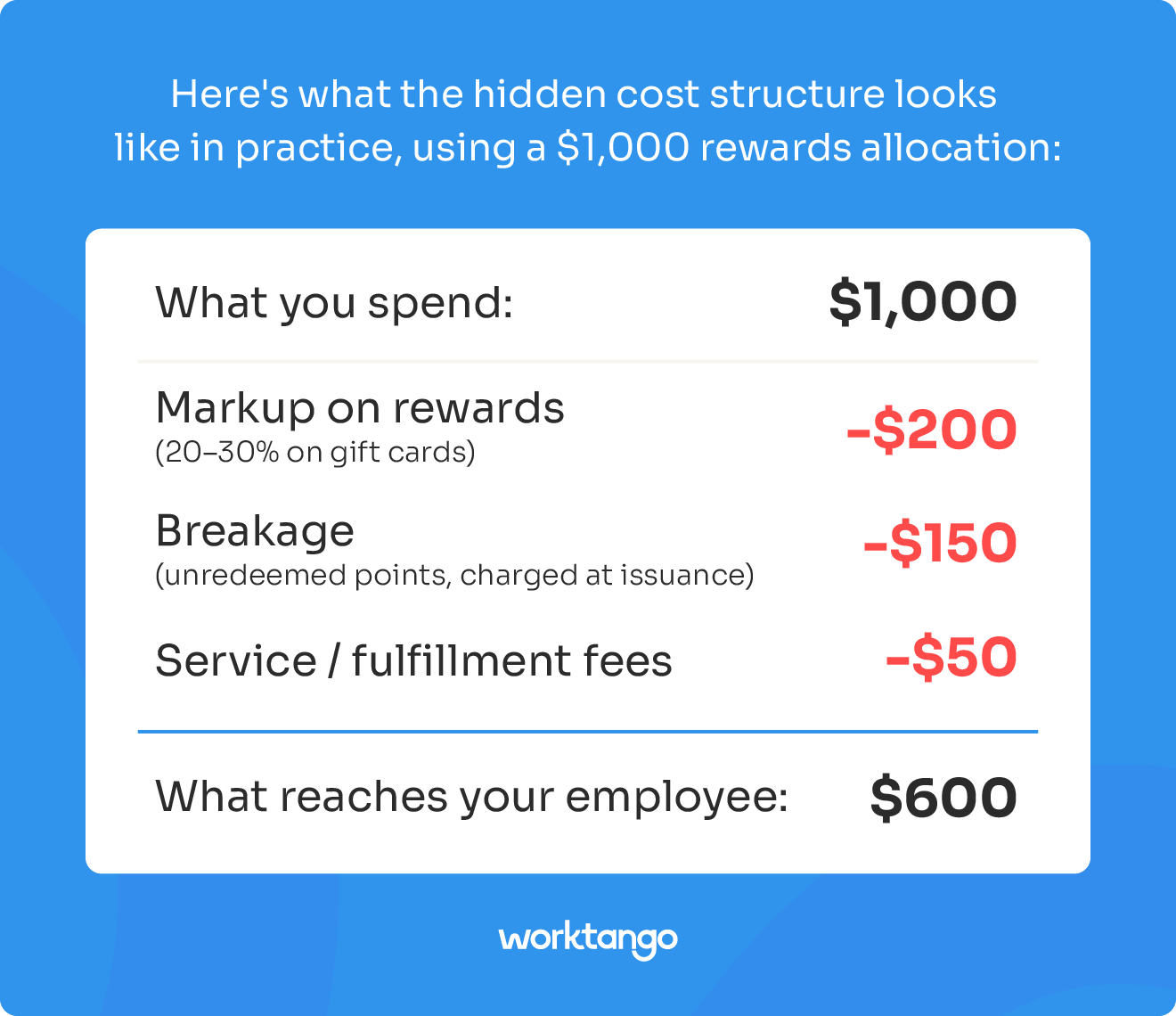
On a $1,000 rewards budget, only $600 reaches the employee. The other $400 goes to the vendor.
Scale this to a real program. A 1,000-person company spending $150 per employee annually on rewards ($150,000 total) could be delivering only $90,000 in actual employee value, with $60,000 going to the vendor through markup, breakage, and service fees.
Over a three-year contract, that's $180,000 that never reached the employees you were trying to recognize.
What a transparent rewards pricing model looks like
Not all recognition platforms operate on a markup model. A transparent rewards pricing model has three characteristics.
At-cost rewards pricing: The platform charges you exactly what the reward costs, with no margin added. 1 point equals 1 cent. Always.
No service fees: Fulfillment, processing, and platform costs are covered by the subscription, not layered onto individual transactions.
Redemption-based billing: You are only charged when an employee actually redeems for a reward. Unredeemed points don't generate revenue for the vendor.
Under this model, a $150,000 rewards budget delivers $150,000 in employee value.
Why this matters beyond budget
The financial impact is significant, but the employee experience impact is equally important.
When employees redeem points for a reward and receive less value than they expected (because the catalog is inflated, fulfillment fees reduce effective value, or point balances erode faster than they can spend them. The recognition moment is undermined, and employees notice even if they can't articulate why.
Recognition programs that deliver on their promise build trust. Programs where employees sense the rewards aren't quite worth what they were told create cynicism about the program itself.
Transparent rewards pricing is a program integrity question as much as a financial one.
How WorkTango approaches rewards pricing
WorkTango operates on a zero-markup model. Rewards are priced at cost, charges occur on redemption not issuance, and there are no service fees.
In practice, that means 1 point always equals 1 cent. What you allocate to employee rewards reaches your employees. The math is transparent, the pricing is predictable, and employees find genuine value in a 10M+ reward catalog that includes merchandise, experiences, travel, charitable donations, branded swag, and custom company rewards across 85+ countries.
For organizations where the rewards math has been a recurring budget concern, the impact compounds quickly. At American Eagle Financial Credit Union, recognition scores rose from 62% to 78% within 12 months of launching WorkTango. A predictable, at-cost pricing structure made the business case straightforward to build and defend.
How to evaluate recognition platforms on pricing
When evaluating recognition platforms, add these questions to your standard RFP or demo checklist.
On rewards pricing:
- What is the markup on the rewards catalog?
- Are there service fees per transaction or redemption?
- Do you bill on issuance or redemption?
- What happens to unredeemed points?
On rewards catalog value:
- What is the total number of reward options available?
- Are rewards available globally, with a consistent experience across countries?
- Are there reward categories that are impactful for every individual employee: merchandise, experiences, travel, charitable donations?
On total cost of ownership:
- What features are included in the base license vs. charged as add-ons?
- Are there limits on recognition activity, admins, or survey responses that trigger additional costs?
Employee recognition is one of the most direct investments an organization can make in its people. When the rewards infrastructure silently redirects a third of that investment to the vendor, the program's impact is diminished. Employees feel the difference, even if they can't articulate why.
The questions are simple. The answers are revealing. Ask them before you sign.
See how WorkTango works for your team. Download the R&R Buyer's Guide to compare platforms on pricing, catalog depth, and total cost of ownership, or get a 30-minute walkthrough to see the WorkTango Rewards Marketplace in action.