

Understanding your employee engagement score can be as clear as mud if you’re unaware of the calculations behind the numbers.
When looking for an employee survey platform for your organization, what do you need to know or ask vendors about their employee engagement score formula?
What is an employee engagement score based on?
For starters, the proper way to arrive at an employee engagement score is to look at the survey “items”, or the statements or questions, that most reflect the theme of engagement.
These items assess employee workplace sentiments such as pride and effort, loyalty, and ambassadorship; factors that sit at the very core of employee engagement.
When you’re presented with an employee engagement score from WorkTango, it’s based on your employees’ responses to the following:
- I would recommend this organization as a great place to work (ambassadorship)
- My organization inspires me to give my very best at work (discretionary effort)
- I intend to be working at this organization a year from now (loyalty/retention)
- I’m proud to work for our organization (pride/enthusiasm)
Together these four survey statements form what the industry refers to as the Employee Engagement Index. Of course, if your organization is used to three or five or six “Index” questions, the flexibility of your survey partner is key.
The employee engagement index score explained
Research clearly shows that when people are engaged at work there are positive outcomes. What the Employee Engagement Index measures is the cognitive and emotional connection people have to their employer.
The Index is juxtaposed against other “factors” like career growth, for example, to see how much that factor or theme influences engagement. In statistician-speak, this is known as regression analysis. If a regression run indicates a high correlation between career growth and engagement, then attention needs to focus on this area.
Other factors that can have an influence on engagement include:
- Senior Leadership
- Direct Managers
- Diversity, Equity & Inclusion
- Trust & Safety
- Enablement
- Goals & Alignment
- Job Satisfaction
- Learning & Development
- Compensation & Benefits
- Recognition
- Team Collaboration
- Company Outlook
How many questions are needed to calculate an employee engagement score?
If just four questions make up the Employee Engagement Index, you might wonder why employee engagement surveys include all sorts of other questions. Quite simply:- To identify pain points
- To identify which workplace factors are driving your engagement score up or down
When you dig deeper using regression analysis, or driver analysis, to identify the factors of highest impact, your employee engagement scores turn into even more meaningful insights.
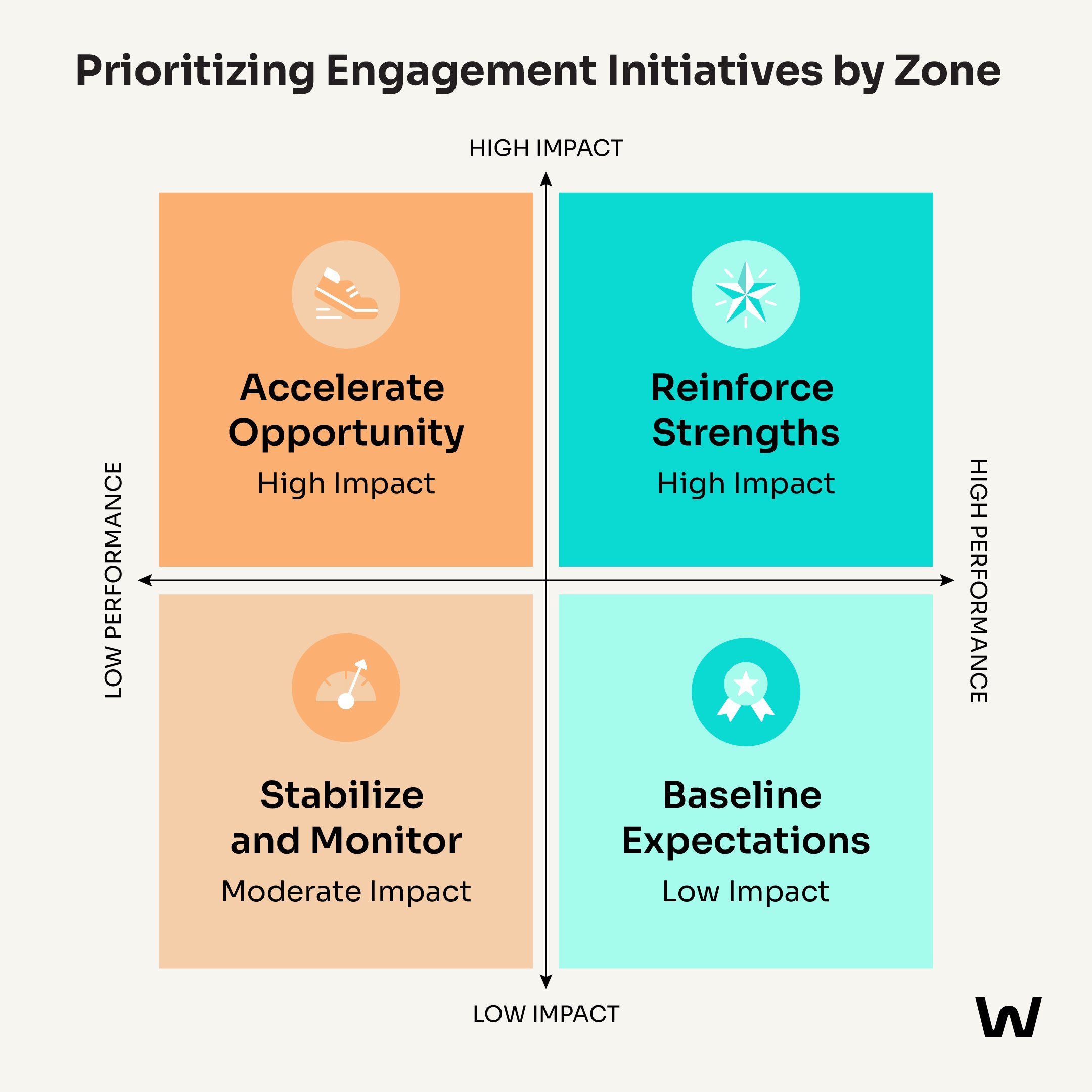
Once you run the analysis, it will rank your engagement factors by impact. The above framework tells you what to do with that information.
The question you need to ask yourself first, long before talking about the kinds and number of questions you want to see built into your survey, is what engagement means or looks like for your organization. An important measure in your organization may be sick days and attrition, or inclusivity factors and their influence on your employees’ sense of belonging. The more questions you ask around drivers like these, the more accurate your factor correlations will be.
For example: for some organizations, one question about career growth might be sufficient. For others, it can be more. Responses to the statement: “This is a good place for me to develop my career” may be overwhelmingly positive. Your executive team could look at that employee feedback and figure “that’s good enough for us.” But if you delve a little deeper, with a second or third survey item asking if employees feel satisfied with the way their career is progressing or if they see opportunities for career growth, and responses are negative your insights become more robust.
What Type of Rating is Best for Employee Engagement Index Scoring and Why?
Likert is the typical rating scale. You can also have drop-down menus, multiple-choice items, yes/no or agree/disagree statements, and open-ended questions to provide context to responses.
Employee engagement is predominantly measured through the Likert five-point scale.
A trustworthy survey vendor will caution against using a scale without a neutral response option, like a 4-point scale (strongly disagree/disagree/ agree/strongly agree). Because when a neutral option is unavailable, negative, and positive responses will be inflated, which can misguide decision-making.
Keep in mind too, that when scales are longer respondents don’t see themselves as easily. It slows down the time to complete a survey. And can result in higher drop-off or incomplete rates.
How are Employee Responses Evaluated?
Different providers have different ways of evaluating responses.
One technique used to determine an employee engagement score is to calculate an average based on all responses: negative, neutral, and positive. However, this approach lacks some primary constructs that make identifying high-impact action items near impossible.
Another more popular employee engagement score formula is the “top box” or “positive percentage” approach on the engagement index where negative and neutral scores are removed from the equation. This method clearly differentiates between “agree” and “disagree” responses. In other words, the proportion of positive and negative sentiments are easy to understand and digest at a glance.
In the WorkTango platform:
- Both groupings of data are visually displayed, versus the average method of calculation which only displays one number.
- Plus, categories and questions can be stacked (ranked from most positive to least positive).
What’s common is that the overall employee engagement score is a calculation of Employee Engagement Index questions combined.
The same calculations apply to any of the (13) other key factors that contribute to engagement and whatever number of associated questions you choose to include in your survey.
How to Assess an Engagement Methodology
So, when looking for a survey platform vendor for your employee engagement needs, know what it is you want your survey to measure.
Ask:
- How can you be certain you’re measuring the right thing? (Read more about survey validity and why it matters).
- What scales are used? Are they well tested?
- Are ratings presented as mean averages or as percentages positive?
Take a tactical approach to find out what drivers most influence your workforce’s engagement.
WorkTango's Surveys & Insights platform handles the full measurement cycle: validated survey design, automated regression analysis, real-time dashboards, and manager-level action plans built in.