The pressure on HR leaders right now is unlike anything we've seen in a long time.
Companies are replacing employees with AI at an alarming rate. The tech industry alone has cut more than 123,000 jobs so far in 2026, with AI listed as the most cited reason for headcount cuts. Boards are pushing for leaner operations and demanding more output from smaller teams. And disengagement levels are rising because employees are watching all of it happen in front of them. They're wondering whether the company sees them as a valued part of the business or just another role that could be automated away.
That puts HR leaders in a difficult position. AI isn't going anywhere, and in most cases, the job now requires it. But the way you choose to deploy AI sends a message to your people, and it’s important to get that message right.
How AI layoffs are driving disengagement and killing ROI
AI layoffs come with a cost. When deploying it purely as a headcount-cutting tool, the math might look clean on paper. But research is starting to pour in, and it's proving that AI layoffs can be a poor business decision.
-
Out of a pool of 350 business executives, 80% reported making AI-driven workforce reductions, but almost none saw meaningful business returns from that decision. Gartner, 2026
-
55% of employers who made AI-driven cuts now regret those decisions, and half are expected to rehire the same roles at even greater cost, especially once the knowledge gaps and productivity losses start to show up. Forbes, 2026
AI can execute a task, but it can't care about your mission. It can't be a champion for your brand, advocate for a colleague, or bring the kind of discretionary effort that actually drives a business forward. That part is uniquely human. When you replace employees with AI, that's exactly what walks out the door with them. Unfortunately, the ripple effects extend far beyond the organizations making those decisions.
AI uncertainty is causing disengagement
If you made AI-driven cuts, the employees who stayed are quietly wondering if they're next. Even if cutting headcount was never part of the plan, employees are watching how AI is being used around them regardless, and they're drawing their own conclusions. This is causing employees to disengage significantly across all industries in 2026.
Anxiety behind workplace AI is one of the most significant drivers of the dip in global workforce engagement levels, which are at an all time low since 2020. Over time, this can cause real harm to your business. Gallup research estimates that low engagement levels cost the global economy $10 trillion in lost productivity in 2025.
To rebuild trust when engagement is at an all-time low, employees need to see that AI is being used to make their workplace better instead of smaller.
How to use AI to improve employee engagement in 2026
Improving employee engagement when AI uncertainty is at its highest comes down to understanding what employees are actually feeling in real time and making sure your managers get that data fast enough to act on it. The right tools make both of those things possible at the speed and scale that actually moves the needle.
Here's how to use AI to improve employee engagement.
1. Use AI to make sense of survey data and surface what matters most
The first part of this equation is collecting employee feedback, which is usually the easiest bit. The harder part is knowing what it's actually saying, which issues are driving disengagement, and where to focus action first. In a time where employee sentiment around AI is shifting fast and managers are burning out, wasting time on survey analysis isn't a viable option anymore.
How AI helps: Use AI to automatically analyze survey responses, surface the themes driving the most disengagement, and rank priorities by impact.
2. Use AI to surface themes and priorities from open-text employee feedback
The most valuable employee feedback rarely shows up in a multiple choice question. It shows up in the comments, the open-text responses, the things employees type out when given space to say what they actually think. Without a way to analyze that qualitative feedback at scale, most of it goes unread.
How AI helps: Use AI to summarize open-text survey responses, identify recurring themes, and surface the sentiment patterns that tell HR leaders what employees are actually feeling beyond what a rating scale can capture.
.png?width=699&height=371&name=worktango-ai-comment-summaries%20(1).png)
3. Action planning that closes the feedback loop fast enough for employees to notice
Most managers want to follow through on employee feedback but don't always know where to start or have the time to figure it out. When that follow-through doesn't happen, employees notice. And in a climate where trust is already fragile, that silence does real damage.
How AI helps: Use AI to automatically generate suggested next steps for each manager based on their team's specific feedback. When managers are guided by AI rather than left to figure it out alone, they spend less time wondering what to do and more time actually leading their people.
4. Recognition that rebuilds the culture of contribution AI uncertainty erodes
When employees feel uncertain about their future, discretionary effort is the first thing to go. Rebuilding it requires recognition that actually lands, specific, timely, and meaningful enough to make someone feel genuinely seen for what they contributed.
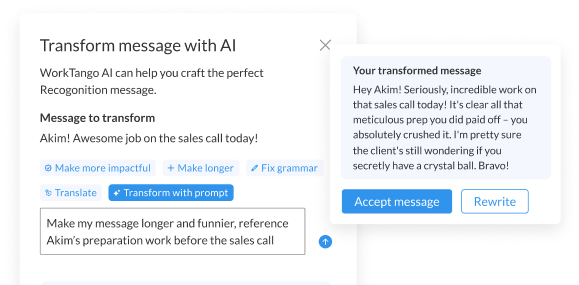
How AI helps: Use AI to evaluate recognition quality across your organization, help employees write more impactful messages, and identify which team members are demonstrating leadership behaviors worth developing.
When these pieces are working together, the impact on employee engagement is hard to miss and even harder to reverse.
How WorkTango AI improves employee engagement
WorkTango has been helping organizations improve employee engagement for years, especially ones going through periods of change and uncertainty. Our newest AI tools make getting there faster, more precise, and more actionable than ever. They were built to enable, never replace.
Surveys & Insights
- WorkTango Coach: instant AI analysis, ranked priorities, and suggested Action Plans delivered directly to managers while feedback is still fresh
- AI Comment Summaries: transforms thousands of open-text survey responses into clear summaries with recommended next steps
- AI Comment Themes: automatically surfaces the most frequently mentioned themes from survey comments as soon as a survey closes
Recognition & Rewards
- AI Recognition Quality Scores: evaluates every recognition message for clarity, specificity, and length, and equips leaders with insights to encourage more impactful recognition
- AI Recognition Writer: helps employees write more meaningful recognition messages with AI-powered refinement, translation, and personality
- AI Leadership Scores & Archetypes: identifies which employees are demonstrating leadership behaviors across five archetypes, helping HR leaders spot development opportunities
For teams looking to go even deeper, Constellation by WorkTango conducts private, personalized AI conversations with your entire workforce simultaneously, surfacing the kind of honest qualitative insight that no structured survey ever captures. Constellation is currently in public beta, but if you're interested in early access, we'd love to talk.
See how WorkTango helps managers lead their teams with confidence during AI uncertainty 👇