

Research by Chris Orebaugh and Luke Davis, WorkTango · Last updated October 16, 2026.
If you run a recognition program, someone will eventually ask why it's important for engagement or your bottom line. Our new research report, How (And Why) Employee Recognition Activity Predicts Engagement, gives you the data to back up your answer.
The numbers in this research come from WorkTango's own platform data. We compared how much employees use WorkTango Recognition & Rewards (R&R) with how they answered engagement survey questions, gathered from 33,416 survey responses across 20 different organizations. Here are some basics that will make the numbers easier to follow:
- Recognition activity is how many actions an employee takes in WorkTango’s Recognition platform. Actions include recognition messages sent and received, comments sent, Incentives claimed, and rewards redeemed.
- WorkTango sorts employees into five groups. Employees with no activity are Inactive. The rest are split into four equal groups by activity: Rarely Active (the lowest 25%), Somewhat Active, Active, and Very Active (the highest 25%).
- Engagement index is one score built from four survey questions. Employees were asked if they would recommend the company as a great place to work, feel inspired to give their best work, plan to stay, and feel proud to work there.
- WorkTango's data compares groups of employees at one point in time. It shows a strong link between recognition and engagement but cannot prove that recognition causes it. All 20 organizations had recognition participation above 50%, so results may look different at a company that is just starting out.
With those basics in place, here are the four key reasons why more frequent employee recognition is important, according to our research.
1. Employee engagement improves with more frequent recognition
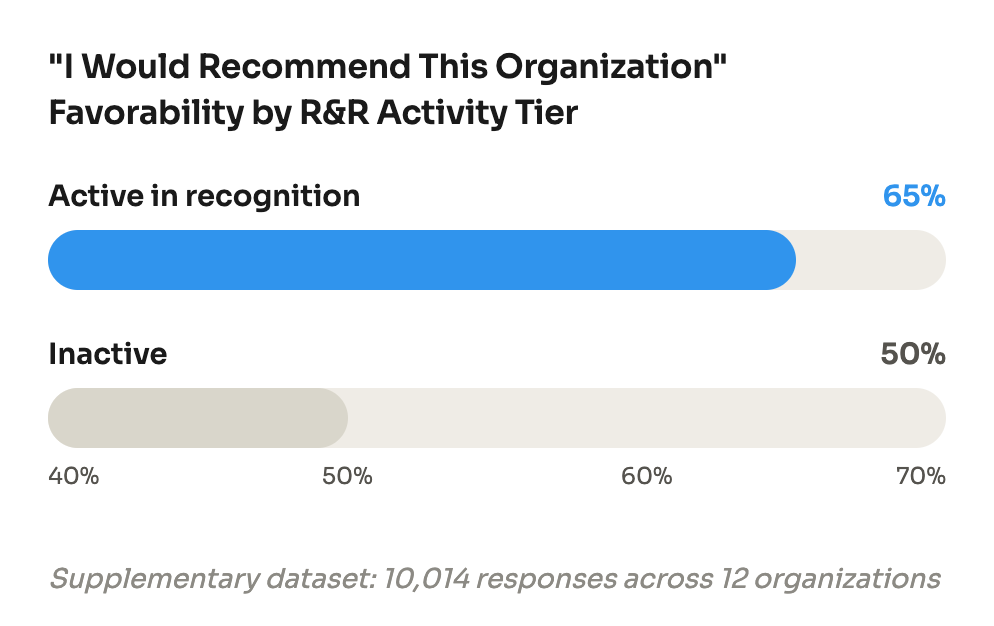
| In WorkTango's data, Active and Very Active recognition users score 8 points higher on engagement than Inactive users (73% vs. 65% across 33,416 survey responses from 20 organizations that use WorkTango Recognition & Rewards). On whether they would recommend their organization as a great place to work, they score 15 points higher (65% vs. 50% across 10,014 responses from 12 organizations). |
Picture two coworkers on the same team. One sends and receives recognition messages from their colleagues often. The other rarely or never does. What we found in our research is that the first coworker is more likely to give positive answers on engagement surveys, and even more likely to say your company is a great place to work.
Employee recognition vs. overall engagement scores
We asked employees if they would recommend the company as a great place to work, feel inspired to give their best work, plan to stay, and feel proud to work there.
- Among employees who send and receive the most recognition (the Active and Very Active groups), 73% scored positively on employee engagement.
- Among employees with no recognition activity (the Inactive group), 65% scored positively.
That is an 8-point difference.
Employee recognition vs. workplace recommendation intent
Out of the four survey questions we asked above for the overall engagement score, we isolated the question: “would you recommend your company as a great place to work?” for deeper research. We wanted to look into this, because the employee Net Promoter Score (eNPS) is built on this very question.
- Among Active and Very Active users, 65% said they would recommend their organization as a great place to work.
- Among Inactive users, only 50% would.
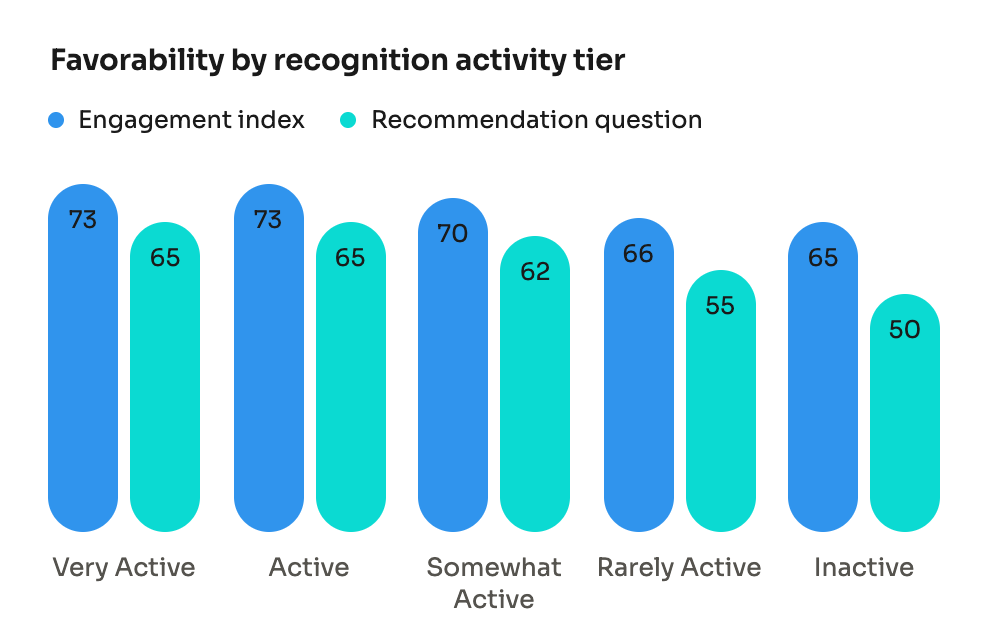
That is a 15-point difference, almost double the 8-point difference on overall engagement. In both engagement and recommendation intent results, scores rise step by step as you move up the five recognition usage groups.
| ⭐ What this means for you. The more employees recognize each other, step by step, the more likely they are to answer positively on engagement and to say they would recommend your company. 💡 What you can do. Start with employees who rarely recognize others or are rarely recognized, and encourage them to take part in peer recognition more often. |
2. Disengagement is easier to spot with more frequent recognition
| In WorkTango's data, employees who rarely or never use recognition show up among low engagement scores more often than expected. Across 33,416 survey responses from 20 organizations, 65% of Inactive users and 66% of Rarely Active users gave positive answers on engagement, compared with 73% of Active and Very Active users. On whether they would recommend their organization as a great place to work, 50% of Inactive users and 55% of Rarely Active users said they would, compared with 65% of Active and Very Active users (10,014 responses from 12 organizations). |
Employee surveys are an important way to hear how people feel at work. However, leaders still need to make decisions about their teams in the time between surveys. Recognition activity is recorded every day with WorkTango’s platform, so we looked at what it can show about engagement risk during that time.
Engagement risk detection
To see if recognition activity can detect engagement risk between surveys, we flipped the question. How much recognition activity do employees with low engagement scores have?
- On overall engagement, 65% of Inactive recognition users and 66% of Rarely Active users gave positive answers, compared with 73% of Active and Very Active users.
The difference was bigger on whether employees would recommend their organization as a great place to work.
- When asked whether they would recommend their organization as a great place to work, 50% of Inactive users and 55% of Rarely Active users said they would, compared with 65% of Active and Very Active users.
Why recognition activity data is important
Surveys are an important way to hear how employees feel, but they come in cycles. Recognition happens every day, whether it’s a shoutout in Slack, a "thank-you" in a team meeting, or a quick “nice work” in passing.
When an employee who used to give or receive recognition often goes quiet, that change can be an early sign their engagement is slipping. The more often recognition happens across your teams, the more of these signals you have to work with, and the sooner you can spot where engagement may be dropping between surveys.
|
⭐ What this means for you. Teams with very little recognition activity are worth a closer look. The pattern points to where to look, and it cannot tell you why. 💡 What you can do. Talk to the managers of teams with little recognition activity, ask how those teams are doing, and compare recognition activity with survey results for each team. |
3. Employee turnover reduces with more frequent recognition
|
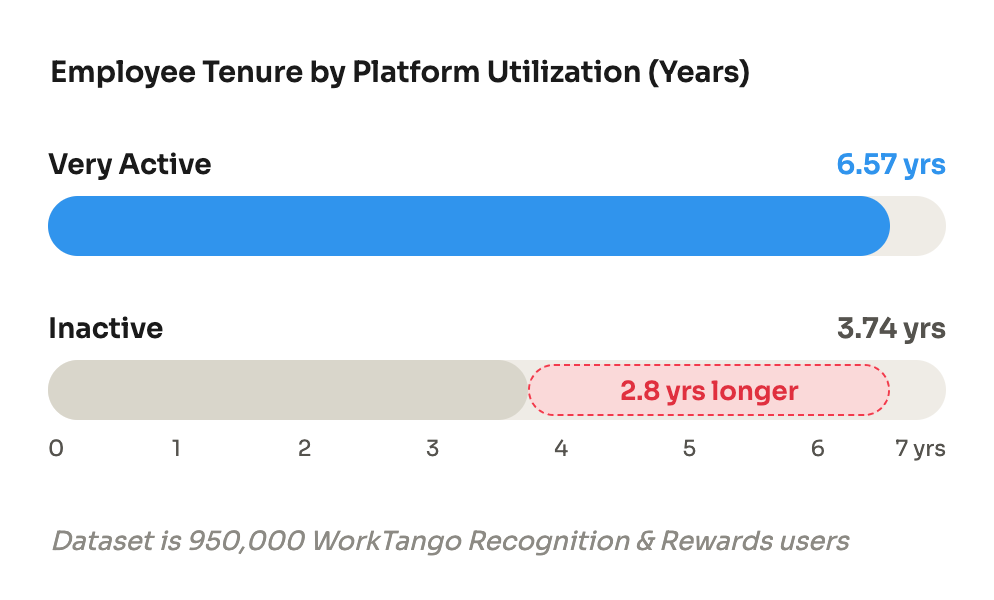
In WorkTango’s data on 950,000 Recognition & Rewards users, employees who recognize each other the most have longer tenure, meaning more time at their company, than employees who never use recognition. Very Active users, the quarter with the most recognition activity, averaged 6.57 years of tenure, compared with 3.74 years for Inactive users, who have no recognition activity. That is a difference of about 2.8 years. |
Let’s take look at how employee recognition usage lines up with employee tenure. Our research found that employees who send and receive recognition often have been at their companies longer than employees who rarely or never do.
How long employees stay
We looked at 950,000 users of WorkTango Recognition & Rewards (R&R) and measured each person's tenure, or how long each person has been at their company.
- Among Very Active recognition users, the average tenure was 6.57 years.
- Among Inactive users, it was 3.74 years.
That is a gap of about 2.8 years.
Why tenure matters
Every employee who leaves has to be replaced. Gallup says replacing someone can cost one-half to two times their yearly pay.
Take a company with 500 employees, a $55,000 median salary, and 100 Inactive recognition users. If those 100 became Active users, that could mean about $248,000 a year in turnover cost reduction savings.*
*This estimate is based on average tenure (3.74 years for Inactive users, 5.64 for Active users) and Gallup’s low-end replacement cost. The full methodology is in the How (and Why) Recognition Activity Predicts Employee Engagement report.
|
⭐ What this means for you. Employees who actively engage in your recognition program will tend to stay at your organization longer, and every person who stays is one you do not have to replace. 💡 What you can do. Find employees who are rarely active in your recognition program. Ask their managers to recognize them directly, by name, and check each month to see who has started to take part. |
4. Team participation grows with more frequent manager recognition
|
In WorkTango's data, teams tend to follow their manager's lead when it comes to employee recognition. Among managers who are Inactive recognition users, 91% of direct reports are Rarely Active or Inactive on the platform. Managers who are Very Active recognition users have direct reports who rank in the top 50% for recognition activity. |
Getting employees to recognize each other can feel like a big job. Our data shows why you should start with managers. Direct reports are the employees who report to a manager.
When managers don’t take part
Among managers with no recognition activity (the Inactive group), 91% of their direct reports were Rarely Active or Inactive recognition users.
When managers do take part
Among managers in the Very Active group, their direct reports ranked in the top 50% for recognition activity.
When a manager sends recognition regularly, direct reports tend to do the same. When a manager does not use the platform, team activity tends to follow that pattern too.
|
⭐ What this means for you. Managers set the pattern for their teams, and teams tend to follow their lead. 💡 What you can do. To drive more recognition at a team level, start with the manager. Train managers to give effective recognition, show them their team's recognition activity, and nudge them to take part before their team is expected to. |
What more recognition means for your bottom line
More recognition goes hand in hand with stronger engagement and lower turnover costs. In WorkTango’s data, Active and Very Active recognition users scored 8 points higher on engagement and 15 points higher on recommending their organization than Inactive users, and Very Active users averaged 2.8 more years of tenure. In our illustration of a 500-person company, that longer tenure could mean about $248,000 a year in avoided replacement costs. Recognition also shows you where engagement may be slipping between surveys, and it spreads fastest when managers lead.
The signal is already in your recognition data. The first step is to ask one manager to recognize one person on their team this week, then get the full research to see where to look next. ⬇️